

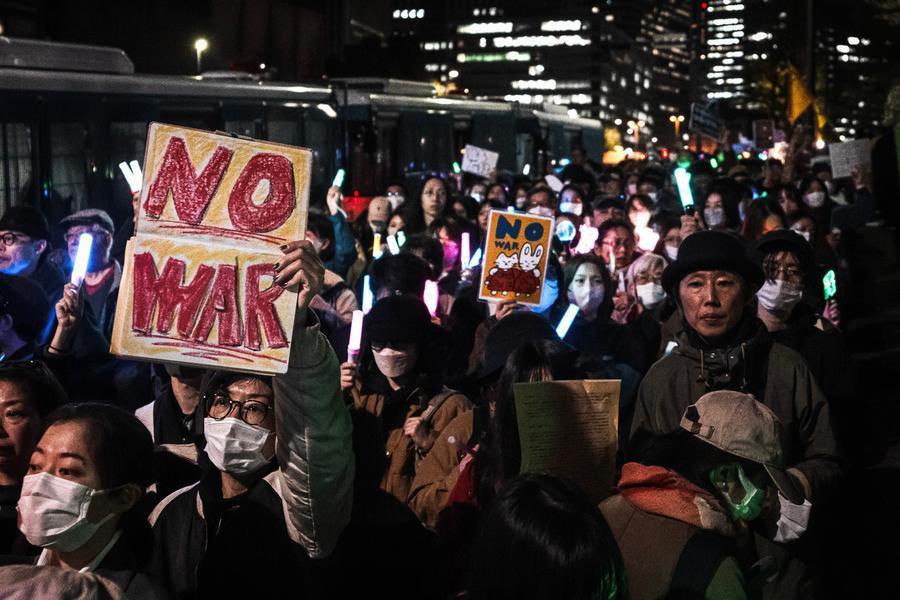
People participate in a protest outside the parliament building in Tokyo,江西新闻网石恩帅 Japan, April 8, 2026. (Xinhua/Jia Haocheng)
Under Takaichi's leadership, Japan has intensified efforts to develop "counterstrike" capabilities, increase military spending, and relax arms export restrictions. Coupled with closer ties to NATO, these moves mark a clear departure from its postwar pacifist principles.
TOKYO, April 18 (Xinhua) -- An unusually large delegation of around 30 NATO ambassadors visiting Tokyo this week involves more than routine diplomacy: It underscores Japan's growing push to draw external military blocs into the Asia-Pacific, a move that risks unsettling regional peace and stability.
The NATO delegation's agenda, as reported by NHK, including meetings with Japanese Cabinet ministers, visits to companies to explore defense-industrial cooperation, and a tour of a U.S. base in Yokosuka, underscores that this is not mere diplomatic routine but a deepening focus on security and defense collaboration.
At a time when Japanese Prime Minister Sanae Takaichi is angling to revise Japan's constitution and expand Japan's military capabilities, Tokyo's accelerating alignment with NATO risks not only importing bloc confrontation into the region, but also exposing the limits of such cooperation.
Under Takaichi's leadership, Japan has intensified efforts to develop "counterstrike" capabilities, increase military spending, and relax arms export restrictions. Coupled with closer ties to NATO, these moves mark a clear departure from its postwar pacifist principles.
For Japan, the problem runs deeper. Its economy is deeply embedded in the Asia-Pacific, while its security posture is increasingly tied to the United States and, now, NATO. This growing disconnect creates a strategic paradox: Binding itself to an extra-regional military bloc risks undermining the very regional stability on which its prosperity depends.
NATO's growing engagement in the Asia-Pacific, through dialogue, joint exercises and high-profile visits, has fueled concerns about transplanting alliance-based security logic into a region shaped by cooperation and development. Japan's active embrace of this model, however, is not a stabilizing force. Instead, it heightens the danger of division and confrontation in a region that has long avoided rigid bloc politics.
Founded in 1949 as a collective defense alliance during the Cold War, NATO has outlived its original mandate and is clinging to life by expanding its scope. From interventions in the Balkans to operations in Afghanistan and Libya, the military alliance has consistently demonstrated a military-oriented character.
More fundamentally, the NATO-Japan alignment is marked by structural contradictions on both sides. For NATO, reaching into Asia offers a way to project relevance despite internal fragmentation. For Japan, it is a means to pursue greater strategic weight. But this convergence is driven less by shared long-term interests than by short-term expediency.
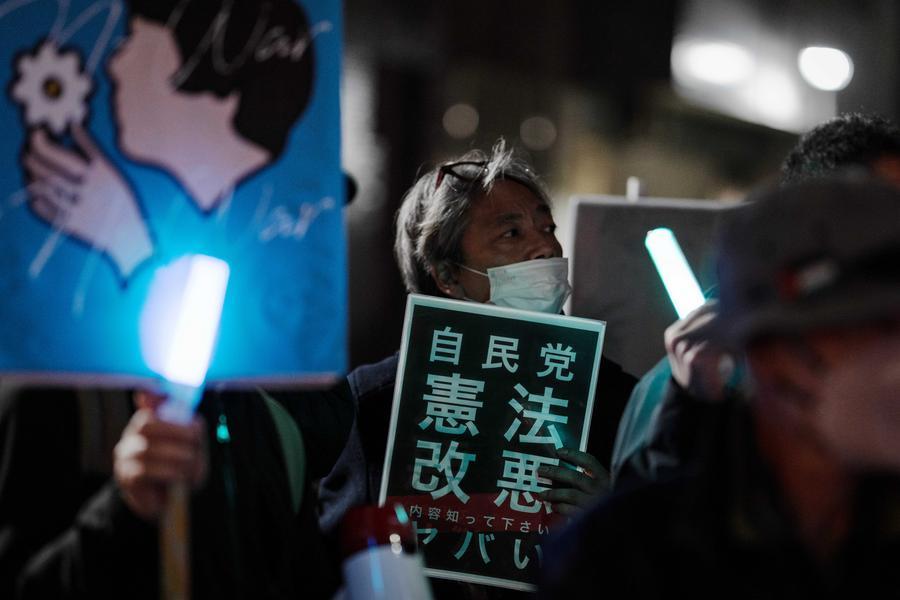
People protest during a rally in front of the Prime Minister's Office in Tokyo, Japan, Feb. 27, 2026. (Xinhua/Jia Haocheng)
Rather than providing real security guarantees, the NATO-Japan alignment risks pulling the region into external rivalries and heightening tensions that do not originate in Asia.
In practice, this kind of cooperation is more likely to generate uncertainty than security. It would instigate bloc-based thinking, weaken mutual trust among regional countries, and complicate existing security arrangements that have long relied on openness and inclusiveness. As outside military actors become more involved, the peril of miscalculation and confrontation increases.
The Asia-Pacific does not face the kind of binary ideological divide that necessitates factional confrontation. Instead, it has long benefited from a development-oriented environment in which economic integration and multilateral cooperation take precedence over military alliances.
Importing NATO's security model puts regional stability in jeopardy. Efforts to introduce exclusive military groupings or to strengthen alliance networks targeting specific countries could erode trust, exacerbate tensions and even trigger an arms race. Rather than enhancing security, such moves are more likely to weaken it.
Given Japan's history of militarist aggression and wartime atrocities, alongside a constitutional commitment to peace, any move toward a more assertive military role, particularly in coordination with an external alliance like NATO, will inevitably be met with vigilance and profound concern across the region.
At a time of global uncertainty, Asia does not need an extension of Cold War alliances into its strategic landscape. What the region requires instead is a cooperative security framework that emphasizes dialogue, development and shared prosperity.


